
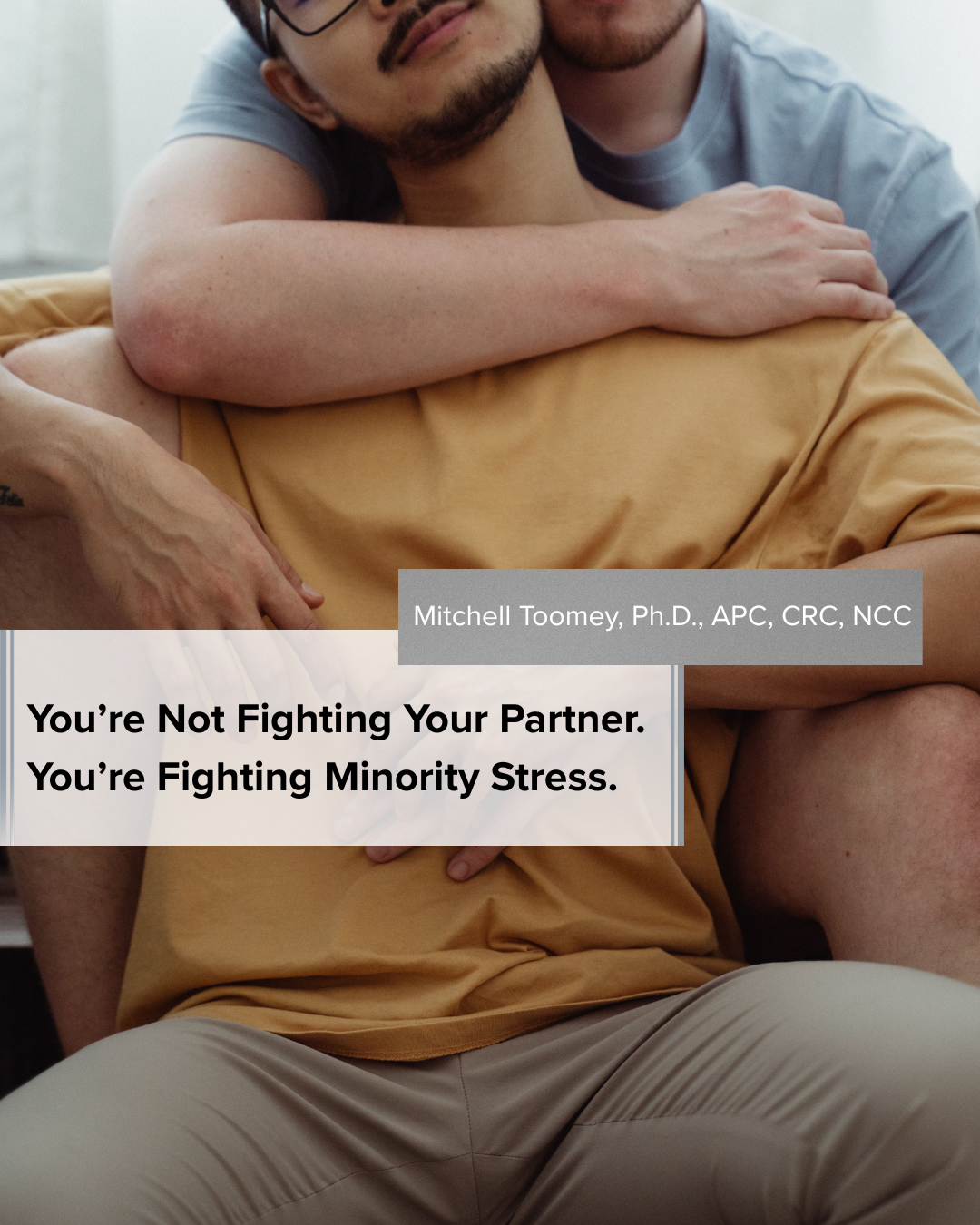
You’re Not Fighting Your Partner. You’re Fighting Minority Stress. by Mitchell Toomey
Relationships do not exist in a vacuum. Relationships are shaped not only by what happens between partners, but also by the stressors happening around them. For queer relationships, that often includes minority stress: the chronic stress that can come from stigma, discrimination, family rejection, invisibility, safety concerns, or navigating systems that were not built with LGBTQ+ relationships in mind. Even when partners feel deeply connected, outside stress can still make its way into the relationship.
Sometimes this stress shows up in obvious ways, such as dealing with hostile family dynamics, workplace discrimination, or worries about political and social changes. Other times, it can be quieter and harder to name: feeling on edge in public, carrying shame from past experiences, disagreements about being “out,” or exhaustion from always having to assess whether a space feels safe. When partners are carrying these burdens, stress can become dyadic stress, meaning it impacts the relationship system, not just the individual. While "dyadic" refers to interactions between two partners, these patterns can occur within any partner relationship, including relationships within polycules and other consensually non-monogamous structures.
Many partners assume stress means something is wrong with the relationship. Often, that is not the case. Loving partners can start feeling disconnected when they are overwhelmed, reactive, or emotionally depleted. One partner may withdraw while the other seeks reassurance. Conflict may increase. Intimacy may decrease. Misunderstandings can grow when the real issue is stress that neither partner caused. This is where dyadic coping becomes important. Dyadic coping refers to how one partner responds to another partner's experiences of stress within their relationship (Bodenmann, 2005; Randall et al., 2017). Positive responses to a partner’s stress may be more emotion-focused, such as demonstrating empathy for the partner’s concern, or problem-focused, such as giving advice and helping understand the concern. Both of these styles of positive dyadic coping responses have been linked to less depressive symptoms and more relationship satisfaction (Regan et al., 2014).
Dyadic coping means learning how to respond to stress as a team rather than as opponents. In therapy, we work on recognizing stress patterns, communicating vulnerably, supporting one another, and creating connection and safety. We also explore how each partner’s unique identities and histories shape the way they experience stress and discuss strengths and resiliencies. Queer relationships can develop incredible resilience because of what they have had to navigate together. Therapy can help strengthen that resilience and turn “me versus you” into “us versus the stress.” Your relationship does not have to carry the weight of the world alone. With support, partners can build deeper connection, shared coping, and a relationship that feels like refuge rather than another source of strain.
-Mitchell Toomey, Ph.D., APC, CRC, NCC
References
Bodenmann, G. (2005). Dyadic coping and its significance for marital functioning. In T.Revenson, K. Kayser, & G. Bodenmann (Eds.), Couples coping with stress: Emerging perspectives on dyadic coping (pp. 33–50). American Psychological Association
Randall, A. K., & Bodenmann, G. (2017). Stress and its associations with relationship satisfaction. Current Opinion in Psychology, 13, 96-106. 10.1016/j.copsyc.2016.05.010
Regan, T. W., Lambert, S. D., Kelly, B., McElduff, P., Girgis, A., Kayser, K., & Turner, J. (2014). Cross-sectional relationships between dyadic coping and anxiety, depression, and relationship satisfaction for patients with prostate cancer and their spouses. Patient Education and Counseling, 96(1), 120–127. https://doi.org/10.1016/j.pec.2014.04.010310